Every software team starts with the same mission: build an exceptional product.
Developers write clean code, designers craft intuitive interfaces, QA engineers execute test cases, and product managers ensure features are delivered on time.
Yet many products still struggle after launch.
The reason isn’t always poor engineering or a lack of innovation.
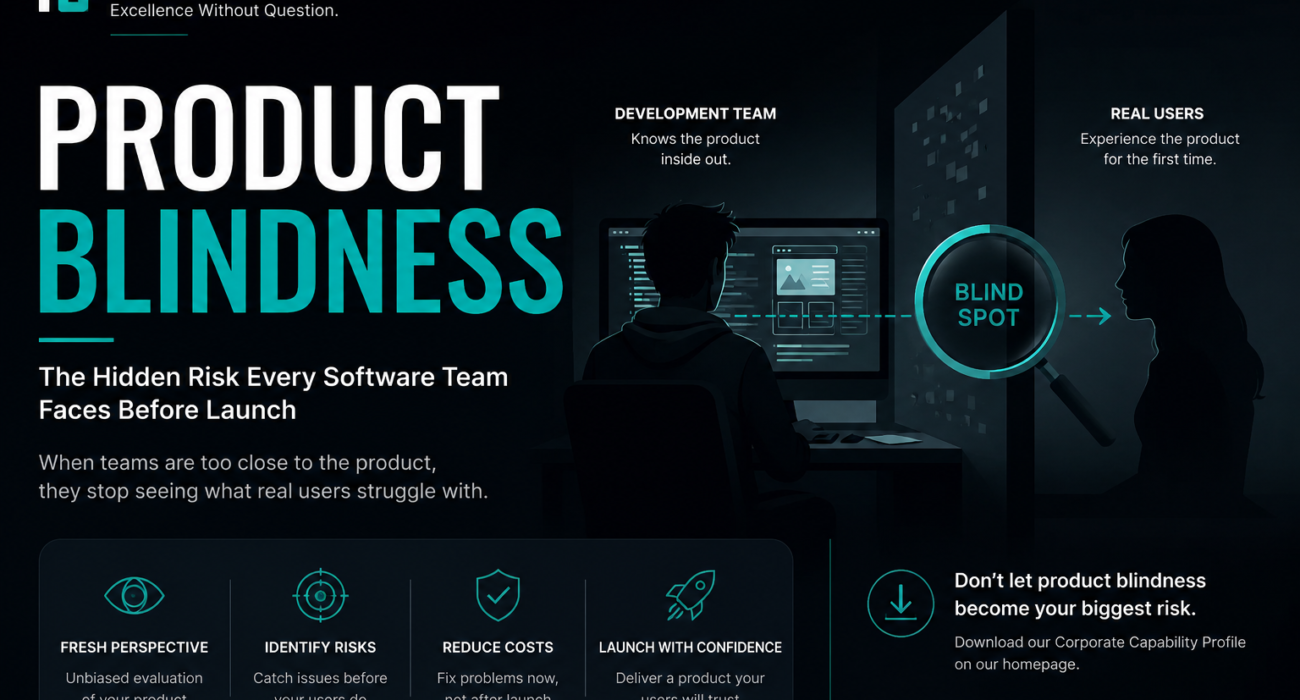
More often, it’s something much harder to recognize—Product Blindness.
What Is Product Blindness?
Product Blindness is the natural inability of internal teams to evaluate their own product from the perspective of a first-time user.
After spending weeks—or even months—working on the same application, teams become deeply familiar with every workflow, every screen, and every feature.
They instinctively know:
- Where every button is located.
- How every process works.
- Which shortcuts to use.
- What each message means.
Your users don’t.
What feels obvious to your team may feel confusing to someone using your product for the first time.
This gap between internal understanding and real-world experience is where Product Blindness begins.
Why Does Product Blindness Happen?
It isn’t caused by poor developers or inexperienced QA engineers.
It’s a result of human psychology.
When people repeatedly interact with the same system, they stop noticing friction because they already know how everything works.
Common examples include:
- Assuming navigation is intuitive because the team designed it.
- Overlooking confusing onboarding flows.
- Ignoring slow performance during internal testing.
- Missing accessibility and usability issues.
- Believing a feature is “easy to use” because everyone internally understands it.
The more familiar a team becomes with a product, the harder it becomes to judge it objectively.
The Business Impact
Product Blindness doesn’t just create technical issues—it creates business risks.
It can lead to:
- Poor first impressions.
- Higher user churn.
- Negative app reviews.
- Lower customer retention.
- Increased post-launch development costs.
- Reduced investor confidence.
Many of these issues are discovered only after real users begin interacting with the product—when fixing them becomes far more expensive.
Why Independent Product Validation Matters
Internal QA remains essential.
However, internal testing alone cannot eliminate Product Blindness.
An independent validation team approaches the product without prior assumptions.
Instead of asking:
“Does the feature work?”
They ask:
- Is this workflow intuitive?
- Will first-time users understand it?
- Does the product perform consistently?
- Are there hidden usability risks?
- Is the software truly ready for launch?
This external perspective helps identify problems that internal teams may unintentionally overlook.
How Relivox Labs Helps
At Relivox Labs, we believe software quality should never rely on assumptions.
Our independent Product Validation approach combines technical assessment, usability evaluation, performance analysis, and quality governance to provide organizations with an objective view of their digital products before launch.
Rather than replacing internal QA, we strengthen it with an unbiased perspective focused on reducing launch risk and improving user confidence.
Final Thoughts
Every software team eventually develops Product Blindness.
It’s not a weakness.
It’s a natural consequence of building the same product every day.
The organizations that recognize this reality gain a significant competitive advantage by validating their products through an independent perspective before customers, investors, or stakeholders experience them.
Because the biggest product risks are often the ones your own team can no longer see.
About Relivox Labs
Relivox Labs is an independent Product Governance and Technical Validation company helping startups, software houses, and enterprises improve software quality, reduce launch risk, and deliver better digital experiences through evidence-based product validation.
Excellence Without Question.